
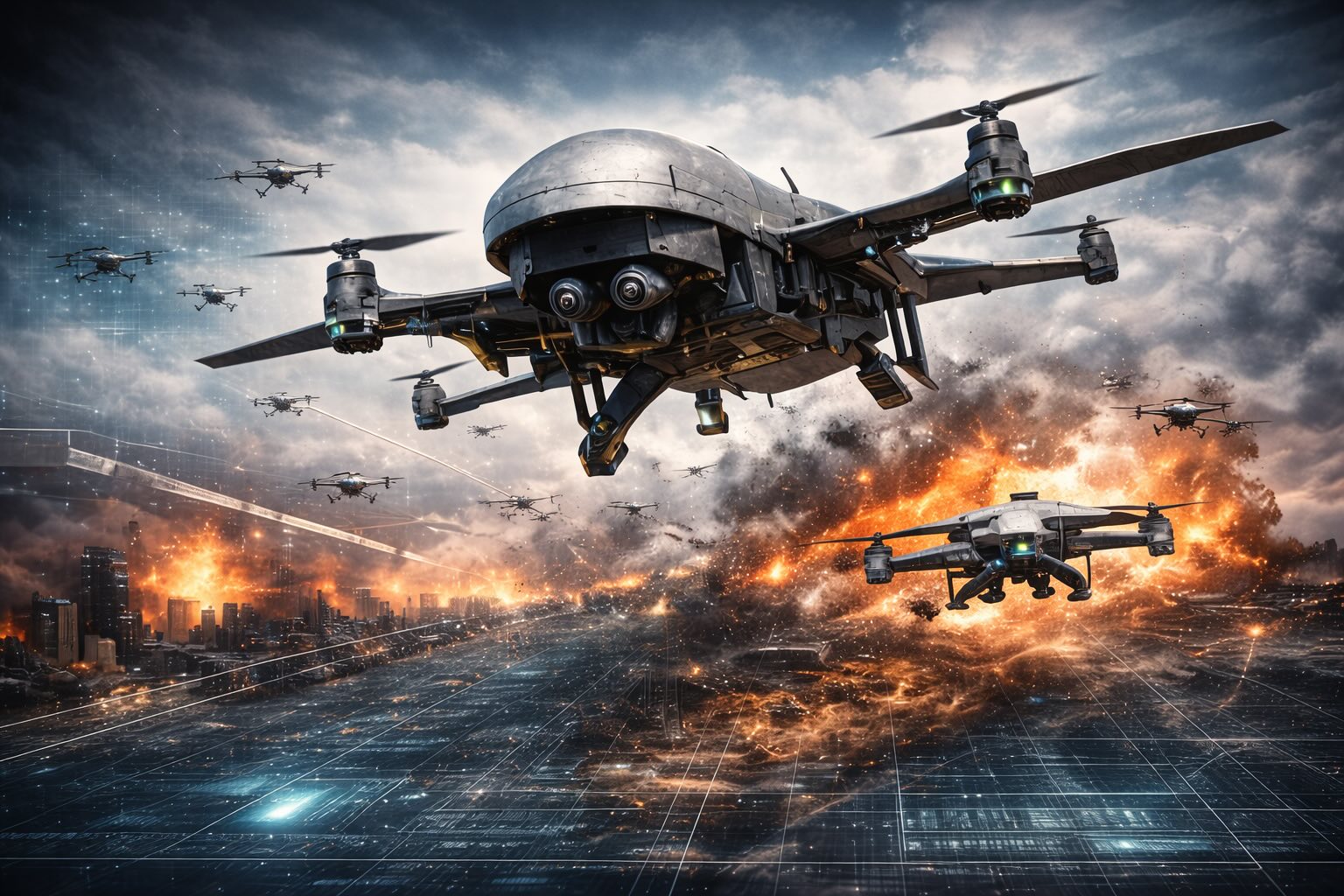
Artificial Intelligence is transforming many industries, but one of the most profound and controversial changes is happening in warfare. AI-powered drones are rapidly becoming a central component of modern military operations, redefining how nations conduct surveillance, combat missions, and strategic defense.
AI drone warfare represents a shift from traditional battlefield engagements to highly automated, data-driven combat systems that can operate faster and more efficiently than human-controlled weapons.
What is AI Drone Warfare?
AI drone warfare refers to the use of unmanned aerial vehicles (UAVs) equipped with artificial intelligence systems that allow them to analyze data, identify targets, and sometimes even make combat decisions with minimal human intervention.
Unlike traditional drones that require remote pilots, AI-enabled drones can:
- Navigate autonomously
- Detect and classify targets using computer vision
- Coordinate with other drones in a swarm
- Adapt to changing battlefield conditions
These capabilities make AI drones a powerful force multiplier for modern militaries.
How AI Enhances Drone Capabilities
Artificial Intelligence dramatically improves the efficiency and effectiveness of drone operations. Some key AI technologies involved include:
1. Computer Vision
AI systems can analyze images and video feeds to detect vehicles, buildings, or individuals in real time.
2. Autonomous Navigation
AI algorithms allow drones to navigate complex environments without continuous human guidance.
3. Swarm Intelligence
Multiple drones can communicate and coordinate like a swarm, overwhelming enemy defenses.
4. Predictive Targeting
Machine learning models analyze patterns to predict enemy movement or behavior.
Advantages of AI Drone Warfare
Reduced Risk to Soldiers
AI drones allow militaries to conduct dangerous missions without putting human lives directly at risk.
Faster Decision-Making
AI systems can process battlefield data far quicker than human operators.
Lower Operational Costs
Compared to fighter jets or large military hardware, drones are significantly cheaper to deploy.
Precision Strikes
Advanced targeting algorithms can improve accuracy and minimize collateral damage.
Ethical and Security Concerns
While AI drone warfare offers strategic advantages, it also raises serious ethical and security concerns.
Autonomous Killing Decisions
One of the biggest debates revolves around whether machines should be allowed to decide when to use lethal force.
Proliferation Risks
As drone technology becomes cheaper, non-state actors or terrorist organizations could potentially access AI-powered weapons.
Escalation of Warfare
AI-driven military systems could accelerate conflicts by reducing the human hesitation involved in combat decisions.
The Rise of Drone Swarms
One of the most revolutionary developments is drone swarm technology. Instead of deploying a single expensive drone, militaries can launch hundreds of small AI-controlled drones that coordinate together.
These swarms can:
- Overwhelm air defense systems
- Conduct large-scale surveillance
- Jam enemy communications
- Perform coordinated attacks
Countries like the United States, China, and Russia are actively developing swarm-based military strategies.
AI Drone Warfare in Modern Conflicts
Recent conflicts have already demonstrated the impact of drones in warfare. AI-assisted drones have been used for:
- Surveillance and reconnaissance
- Precision strike missions
- Electronic warfare
- Border monitoring
As AI improves, the role of autonomous drones is expected to expand dramatically.
The Future of AI in Military Technology
The next generation of AI drone warfare could include:
- Fully autonomous combat drones
- AI-controlled drone swarms operating across air, land, and sea
- Integration with satellite intelligence systems
- Real-time battlefield decision-making powered by AI
However, international regulations and treaties may be necessary to control how autonomous weapons are used.
Conclusion
AI drone warfare is rapidly reshaping modern military strategy. While these technologies promise greater efficiency, precision, and reduced risk for soldiers, they also raise significant ethical and geopolitical challenges.
The global community must carefully balance innovation, security, and ethical responsibility as AI continues to redefine the future of warfare.